



Why Your Site Needs an International SEO Audit
Your site ranks well at home. Then you launch German, UK and Spanish versions, and months later they barely appear in search results. Usually the search engine is showing the wrong version, or skipping some completely.
Here's why it matters:
- 76% of online shoppers prefer product information in their own language (CSA Research).
- 40% never buy from websites in other languages (same survey).
- 67% of domains using hreflang have at least one issue (Ahrefs study of 374,756 domains).
- 56.3% of those domains miss an x-default tag, and 15.3% miss return links (same study).

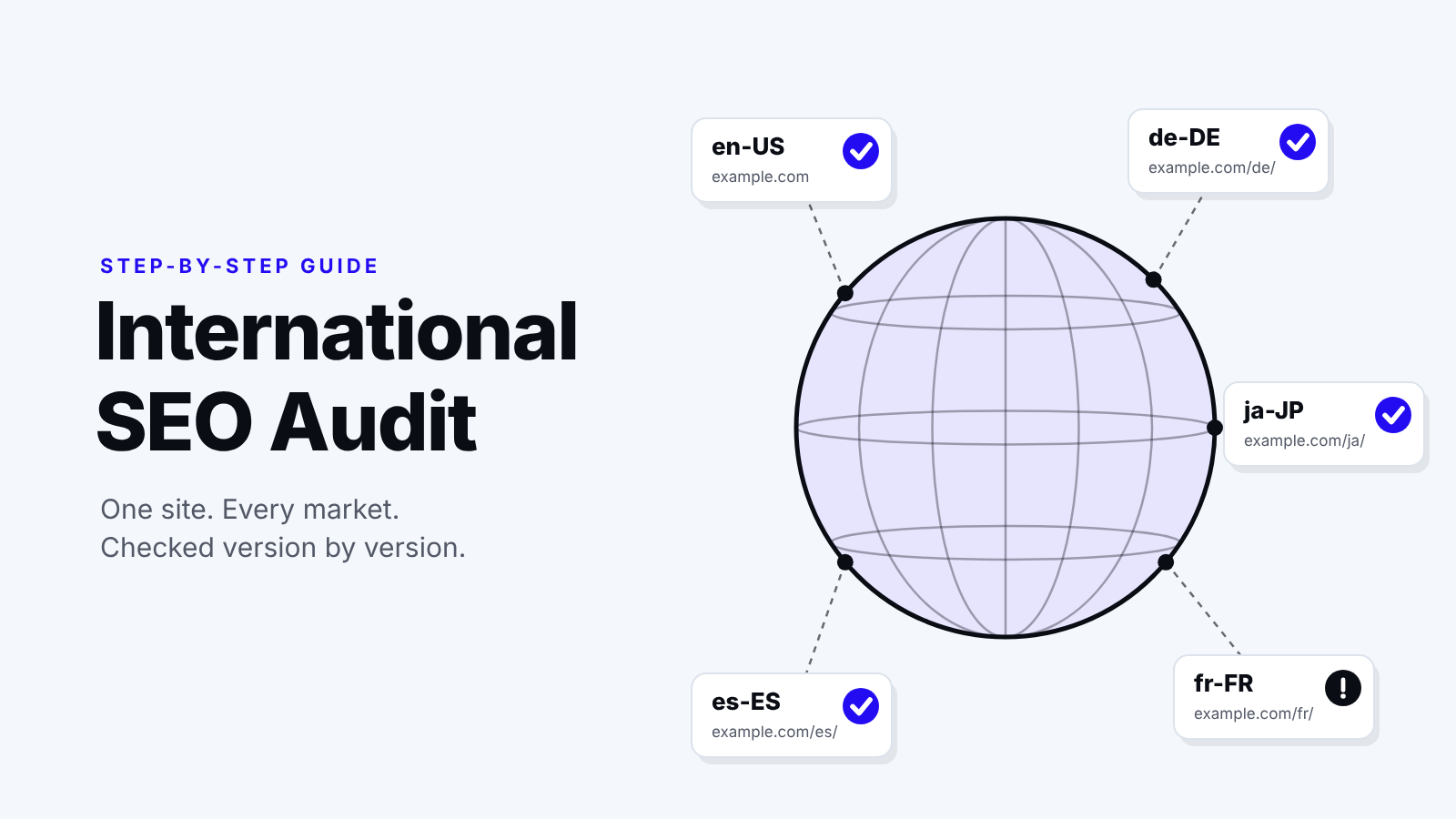
An international SEO audit finds out why. It checks how your site labels each language and region, and whether search engines can crawl and index every version. In this SEO audit guide, we'll walk you through five simple steps, the best SEO audit tools and a free checklist.
What Is International SEO?
International SEO is search engine optimization for more than one country or language. It makes sure every search engine shows people the right version. You structure, label, localize and optimize each version to help search engines match it to the right market.
It's more than translation. A page with no clear market signal won't earn a strong Google ranking.
Benefits of International SEO
- A better user experience. A buyer in Germany sees German pricing and navigation, not dollars.
- Stronger ranking in each market. Each localized page ranks on its own.
- Lower cost per market. Unlike paid digital marketing, organic traffic keeps working after you stop spending.
- A better conversion rate. Local language and currency help visitors sign up.
What Is Included in an SEO Audit for International Sites?
An international SEO audit covers a regular technical SEO audit, plus checks for multiple country versions. SEO for international sites breaks in the same few places, and good international SEO audits check them all.
| Area | What the audit checks |
|---|---|
| International targeting | Hreflang tags, codes, x-default, return links |
| URL and site structure | ccTLDs, subdomains or subfolders, and consistent URLs |
| Content localization | Content quality, local keywords, a localized meta description per page, no duplicate content |
| Crawling and indexing | Every version can be crawled, with no broken links |
| Page speed by region | Load time and Core Web Vitals for distant users |
| Local signals | Off-page SEO: a local backlink profile, addresses, currency |
| SEO performance | Ranking and conversion per country |
You'll end up with an actionable list of SEO issues to prioritize for each market.
How to Do an International SEO Audit (Step by Step)
If you've run a regular website audit, this will feel familiar. To perform an SEO audit across countries, repeat the same audit process per market.

Step 1: Check International Targeting (Hreflang and Geotargeting)
International targeting in SEO tells Google which page is for which audience. Using Google's hreflang guidelines, check that:
- Every page lists itself and its alternates.
- Return links exist. If English points to German, German must point back.
- Codes are valid, like
en-gb, noten-uk. - An x-default is set for visitors whose language you don't serve.
- You use one method: the HTML head, HTTP headers or an XML sitemap.
Google has retired Search Console's International Targeting report, so hreflang and local signals do that job now.
Step 2: Review URL Structure
Check that each market follows one consistent pattern. Google's multi-regional guide compares the options.
| Structure | Example | Strengths | Watch out for |
|---|---|---|---|
| ccTLD | example.de | Strongest country signal | Costly per country |
| Subdomain | de.example.com | Easy setup | "de" can read as language or country |
| Subfolder | example.com/de/ | Easy setup; one domain | One server location |
| URL parameter | example.com?loc=de | None | Google doesn't recommend it |
Step 3: Audit Content Localization
This step is a content audit for each language, covering the SEO elements on all the pages on your website.
- One language per page, with translated main content, not just menus.
- Self-referencing canonicals on same-language pages, such as US and UK, so they aren't seen as duplicate content.
- Local keyword research, because search intent and wording change from country to country.
- Localized on-page SEO, so each page has its own title, meta description, alt text and anchor text.
Step 4: Check Crawling, Indexing and Speed by Region
- One property per version. Add each subfolder or subdomain to Search Console, and confirm Google can index it.
- No automatic redirects. Googlebot mostly crawls from the US, so use a language switcher instead.
- Canonicals that don't cancel hreflang. Each page's canonical should point to itself.
- Page speed for distant users. Site speed is a ranking factor, so test each version in Google PageSpeed Insights. A CDN often helps.
Step 5: Review Local Backlinks and Signals
Look for links from local media and partners in each country. Also check for a local address, phone number and pricing, marked up with structured data.
Want a second pair of eyes? Book a free strategy call with Turtlehead, and we'll happily show you what to fix first.
International SEO Checklist
Use this checklist for each market during SEO auditing. Anything unchecked goes on your fix list.
- Self-referencing hreflang tags on every page
- A matching return link for every hreflang tag
- Valid codes (en-gb, not en-uk) and an x-default page
- One URL pattern per market, never URL parameters
- Each version set up as its own Search Console property
Free Download: The International SEO Audit Checklist
Get the full checklist on one printable page, and use it as your SEO audit template on every project.

⬇ Download the free SEO audit checklist (PDF, 1 page)
International SEO Tools for Auditing and International SEO Tracking
Most SEO auditing tools work internationally once you set them up per market.
| Job | Tool | How to use it |
|---|---|---|
| Coverage by market | Google Search Console | One property per country version |
| Hreflang and site audits | Semrush or Ahrefs Site Audit | Flag hreflang conflicts, broken links and duplicate pages |
| International SEO tracking | The rank tracker in your SEO suite | Check keyword ranking per country |
| Speed by region | WebPageTest | Test from your markets |
| Analytics and conversion | Google Analytics | Compare website traffic and bounce rate from organic search, by country |
US rankings tell you nothing about your search visibility in Germany, so track every market.
International SEO Best Practices
- Launch fewer markets, properly. Two well-localized markets beat eight half-finished ones.
- Pick one URL structure and document it.
- Build hreflang into your CMS or sitemap, so every new page launches with its alternates and is optimized for search engines.
- Let users choose their version instead of redirecting them.
- Optimize each market on its own, with its own keywords, content strategies and internal linking.
- Re-audit after big changes, like a redesign, migration or new market.
When to Hire an International SEO Consultant or International SEO Expert
You can handle most SEO auditing yourself. An international SEO consultant or expert helps when you're launching several countries or planning a migration.
International SEO Specialist vs. International SEO Company
| International SEO specialist | International SEO company | |
|---|---|---|
| Best for | A focused on-page SEO audit or one technical SEO problem | Ongoing work across markets |
| What you get | One expert's deep SEO analysis | A team for technical SEO, on-page optimization, content and links |
What to Expect From International SEO Services and Packages
Most providers offer a one-off comprehensive SEO audit or a monthly optimization retainer. A good provider prioritizes fixes by impact and reports by market. When comparing international SEO packages, check how many markets and pages are included.
Final Thoughts
International SEO auditing doesn't have to be hard, and it protects your SEO efforts in every market. Most problems come from a few causes: one-way hreflang tags, wrong canonicals or redirects that hide a version. Start with Step 1, then optimize one market at a time.
Ready to grow beyond your home market? Book a free strategy call with Turtlehead, and we'll help you find what's holding your site back.
FAQs on International SEO Audit
How Long Does an International SEO Audit Take?
Thorough SEO auditing of a small site with two or three versions takes a few days. A large multi-domain site takes weeks.
How Often Should You Audit an International Website?
Run a complete SEO audit once a year and after any redesign, migration or new market. Check hreflang errors monthly.
How Much Does International SEO Cost?
It depends on your markets, pages and whether you need a one-off comprehensive audit or ongoing help.
Can I Do an International SEO Audit Myself?
Yes. Google Search Console, an SEO auditing tool and our checklist cover most of it.
What Should an International SEO Strategy Include?
It should cover URL structure, hreflang, local keyword research, local links and search engine ranking reports per country.
Do I Need International SEO Consulting Before an Audit?
Usually not. Most international SEO consulting starts with an audit anyway.